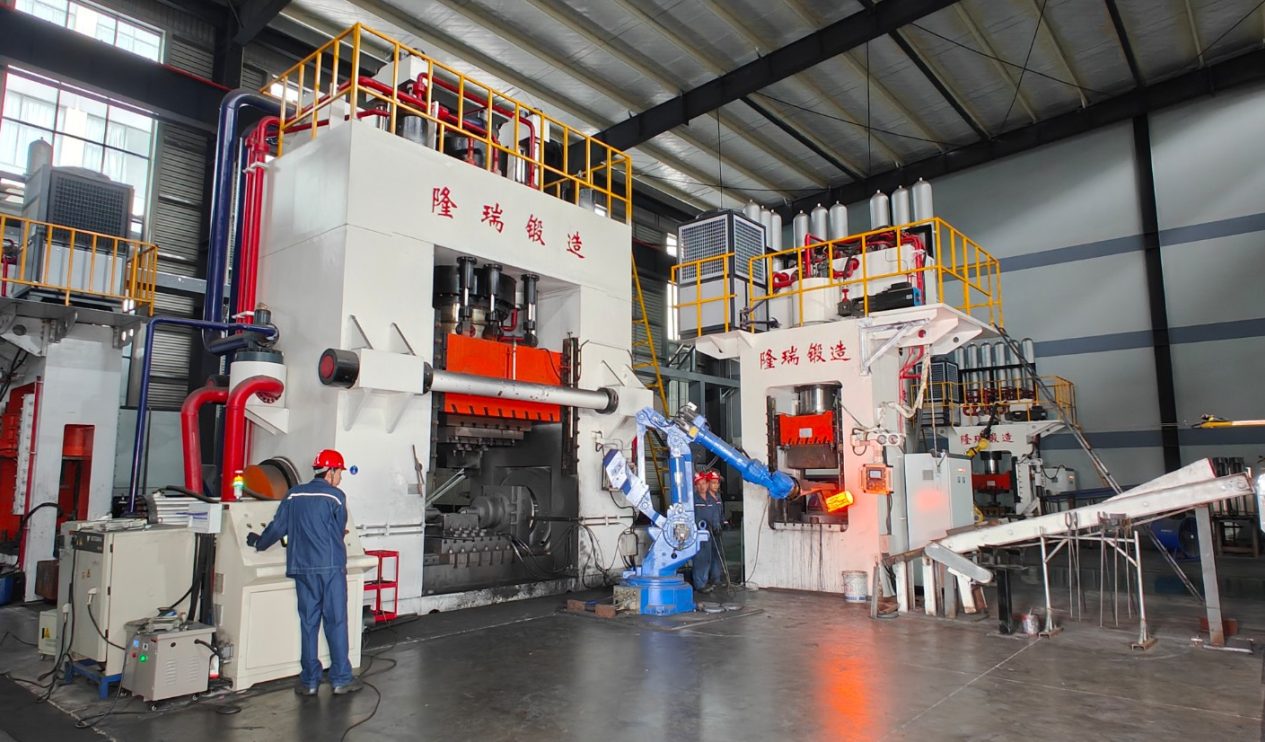
Longrui Forging is a closed die forging manufacturer in China. We form heated steel between shaped dies on multi-directional hydraulic presses of 6,000 T, 3,000 T and 2,000 T, producing parts from 5 kg to 520 kg. We design and make our own dies, and we heat treat, test and machine the parts in the same plant.
What Closed Die Forging Is
Multi-directional die forging is designed to be flashless: in principle it removes the large lateral flash of open die forging. In production, blank weight tolerances and the difficulty of controlling metal flow in complex parts still leave small longitudinal fins, and under some conditions local flash that has to be controlled.
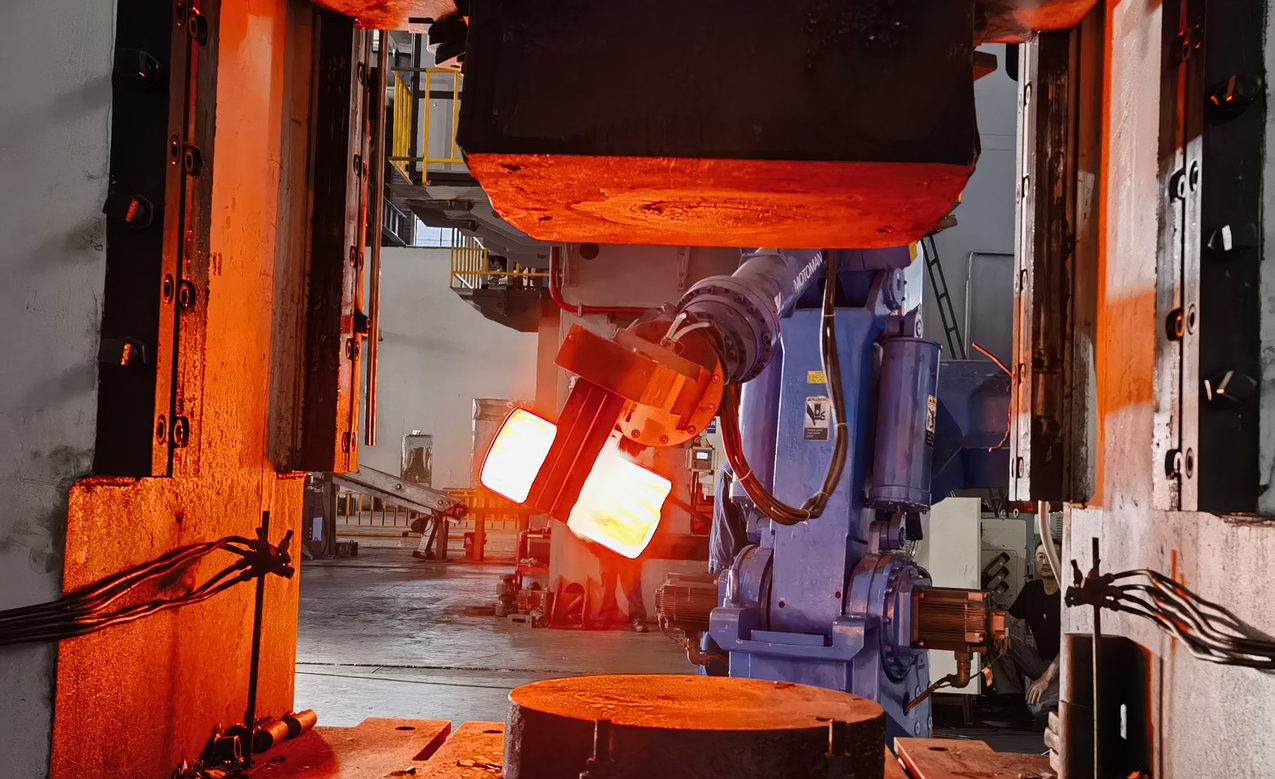
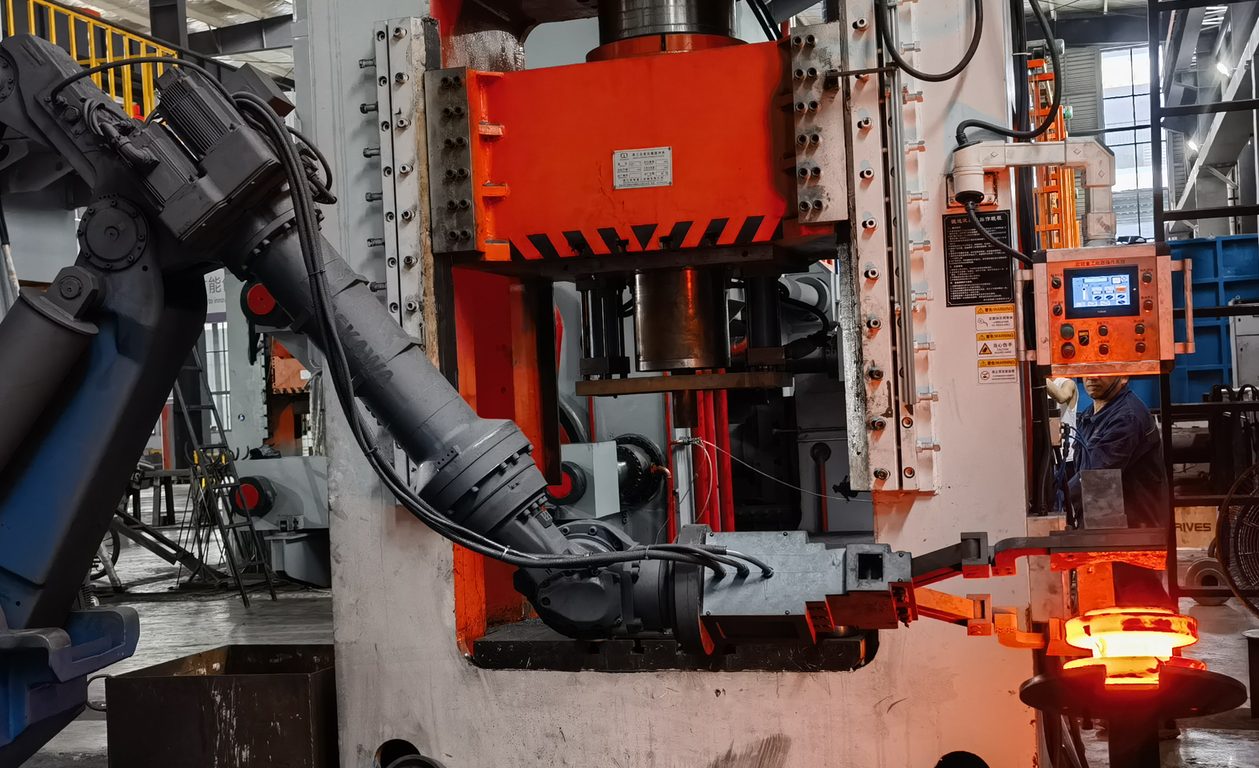
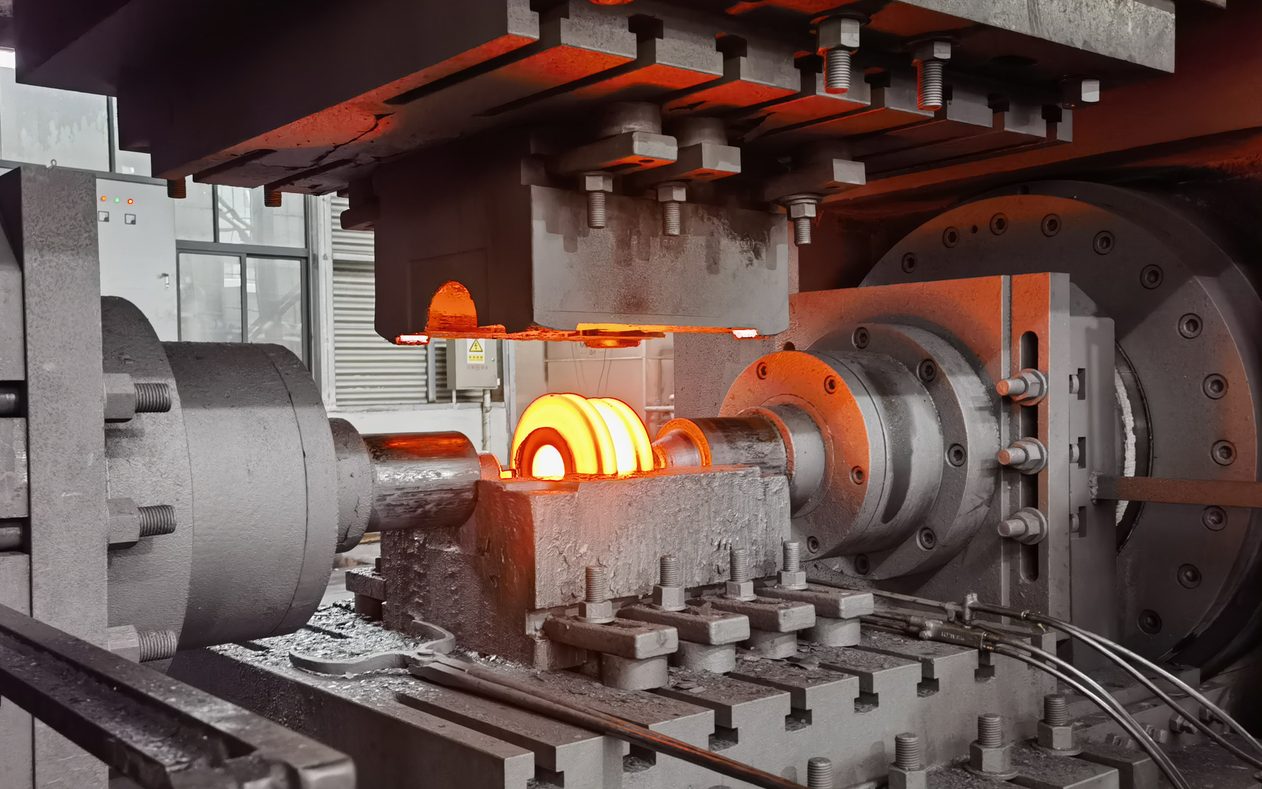
In closed die forging, also called impression die forging, a heated steel billet is formed between two dies that carry the shape of the finished part. The steel fills the die cavity under pressure, and the surplus leaves as flash around the parting line.
It is one of the hot forging processes: the billet is brought to forging temperature first, and the part is formed in a few strokes instead of being built up shape by shape.
The same process is written several ways. Closed die forging, die forging and impression die forging all mean this route; older drawings say drop forging, after the hammer that used to do the work. When the material is named instead of the tooling, buyers speak of metal forging or steel forging, which is the same forming operation on a different grade. However the requirement is worded, what is being asked for is a shaped die, a controlled temperature and flash that is trimmed off after forming.
Three things follow from that, and they are the reason buyers specify it:
- Grain flow follows the part contour. The metal fibres bend along the shape instead of being cut through, which is what gives forged parts their fatigue and impact behaviour.
- Near-net shape. The part comes out close to final form, so less steel and less machining are needed to finish it.
- No casting porosity. The material is solid and worked, with no gas holes or shrinkage cavities inside.
| Open die forging | Closed die forging | |
|---|---|---|
| Shaping | Between flat or simple dies, shape built up by successive blows | Between two shaped dies, part formed in a few strokes |
| Size | Very large parts, low volume | Repeated parts, from about 5 kg to 520 kg |
| Tooling | Little or none | A die set for each part |
| Typical use | One-off heavy parts | Valve bodies and covers, gears, flanges, hydraulic and machinery parts |
Tooling is required for every new part, so closed-die forging suits parts you will order again rather than one-offs. For parts above our die-forging range, an open-die forging is supplied by another plant in our group instead (see Capability).
What We Forge
- Ball valve bodies and covers (bonnets) from 1/2″ to 12″, Class 150 to 2500; see the valve body page
- Valve components, flanges and rings
- Gear blanks and gear parts, see the gear blanks page
- Hydraulic cylinder components and pipe fittings
- Power station valve parts (F91, F92, WB36)
- Construction and mining machinery parts, wheel hubs, bridge components
- Your own parts: send a drawing in PDF, DWG or STEP
Our Presses and Size Range
| Press | Force | Forging weight range |
|---|---|---|
| Multi-directional press No.1 | 6,000 T (60 MN) | 150 – 520 kg |
| Multi-directional press No.2 | 3,000 T | 30 – 150 kg |
| Multi-directional press No.3 | 2,000 T | 5 – 30 kg |
- Largest single forging: 520 kg (presses capable of up to 800 kg, subject to part structure review)
- Largest machining size: Ø600 × 1000 mm
- Annual die-forging capacity: 15,000 tonnes
The presses are multi-directional, so they work the steel from more than one direction in the same stroke. That is what lets us form parts with deep cavities, such as valve bodies, without welding them up from pieces. When closed die forging in China is being compared, these two numbers are the ones worth asking about first, the tonnage and the number of directions, followed by who makes the dies: ours are designed and cut in house.
Dies and Tooling
Die design is done in house. We hold 5 granted patents on closed-die and multi-directional tooling, including an invention patent for a multi-directional forging die for valve covers with a quick-change insert structure, and utility models covering a quick-release combined valve-cover die and a replaceable rear-cylinder punch for valve bodies.
Quick-change die design keeps re-tooling time short when a part is revised, and it is one of the reasons our valve bodies and covers hold their dimensional consistency across batches.
How the Part Is Made
The closed die forging process here is the same for every part, and the press is one stage of it rather than all of it. Every forging moves through the same 11 controlled stages: material inspection by spectrometer, saw cutting to forging weight, heating in a controlled furnace, pre-forging by robotic manipulator, closed-die forging on the forging press with infrared temperature monitoring, grinding and surface inspection, heat treatment, mechanical testing, non-destructive testing, machining and dimensional check, then final XRF verification and dispatch. The details and photos are on the manufacturing process page.
Materials
We forge carbon and low-temperature, alloy, stainless, duplex and super duplex, nickel alloys and structural steels. The materials page lists the grades, and the service each one is chosen for.
Quality Behind the Forging
Forging is only half of what a buyer is buying; the paperwork is the other half. We are certified to API Spec 20C for closed-die forgings and hold NORSOK M-650 material manufacturer qualification, plus PED 2014/68/EU and AD2000-W0 from TÜV NORD, BV Mode II and ISO 9001/14001/45001. UT, MT and PT are performed in house and mechanical tests run in our own laboratory; every shipment leaves with material certificates and test reports. More on the certifications page and on what API 20C and NORSOK M-650 cover.
Related Reading
Frequently Asked Questions
What is the difference between closed die forging and casting?
Closed die forging works solid steel under pressure, so the part has continuous grain flow, no internal porosity and higher toughness. Castings are poured into a mould and can carry shrinkage cavities and gas holes. For pressure-containing and safety-critical parts, forging is normally the specified route. Final properties and internal quality depend on the grade, on the heat treatment specified for that grade and for your requirements, and on the NDT scope agreed with you; they are verified against the inspection requirements on the order.
How heavy a part can you forge?
5 kg to 520 kg on our three presses. The 6,000 T press covers 150–520 kg, the 3,000 T covers 30–150 kg and the 2,000 T covers 5–30 kg. Our equipment can reach 800 kg subject to a review of the part structure.
Do you make the dies yourselves?
Yes. Die design and manufacture are in house, which is also where our 5 tooling patents come from. For a new part we review the drawing for die-forging feasibility first, then work out the tooling and quote.
Which materials can you forge?
Carbon, low-temperature, alloy, stainless, duplex and super duplex steels and nickel alloys including A105, A350 LF2, 4130, 4140, F91, F92, F304, F316, 420, 17-4 PH, F51, F53, F55, 625, 718 and 825. See the materials page.
Do you supply as-forged or machined parts?
Both. We can ship the forging as it comes off the line, or machine it to your drawing up to Ø600 × 1000 mm with dimensional and NDT reports.
How do I start an order?
Send a drawing (PDF, DWG or STEP) and we will tell you whether the part is a candidate for closed-die forging, what tooling it needs and what it would cost; the RFQ form and the email address are on the contact page.
What is the difference between open die forging and closed die forging?
Open die forging shapes the part between flat or simple dies and builds the form up over successive blows, which suits very large parts in low volume. Closed die forging uses a die set that carries the shape of the part, so the form repeats from piece to piece and less material is left for machining. The table above compares the two; we run closed die forging on our own presses, and an open die forging is supplied by another plant in our group where a part is above the die-forging range.
Is drop forging the same as closed die forging?
Drop forging is the older name for the same idea, impression die forging, and it comes from the drop hammer that formed the part by falling weight. At Longrui the work is done on hydraulic presses, not drop hammers, and from more than one direction, which is what allows deep cavities such as valve bodies to be formed rather than welded up from pieces.
What is flash in die forging?
Flash is the thin fin of surplus steel squeezed out of the die cavity at the parting line. It shows the cavity filled completely and it is trimmed off after forming. The die carries a flash land around the cavity that controls how the surplus escapes, and holding the part under load while that happens is what drives the steel into the last corners of the shape.